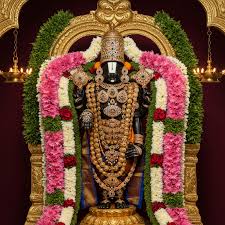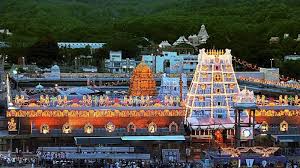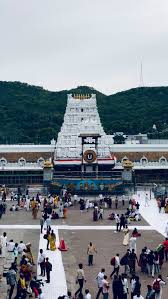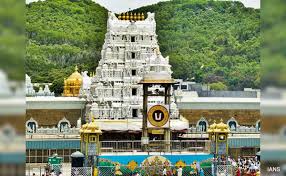
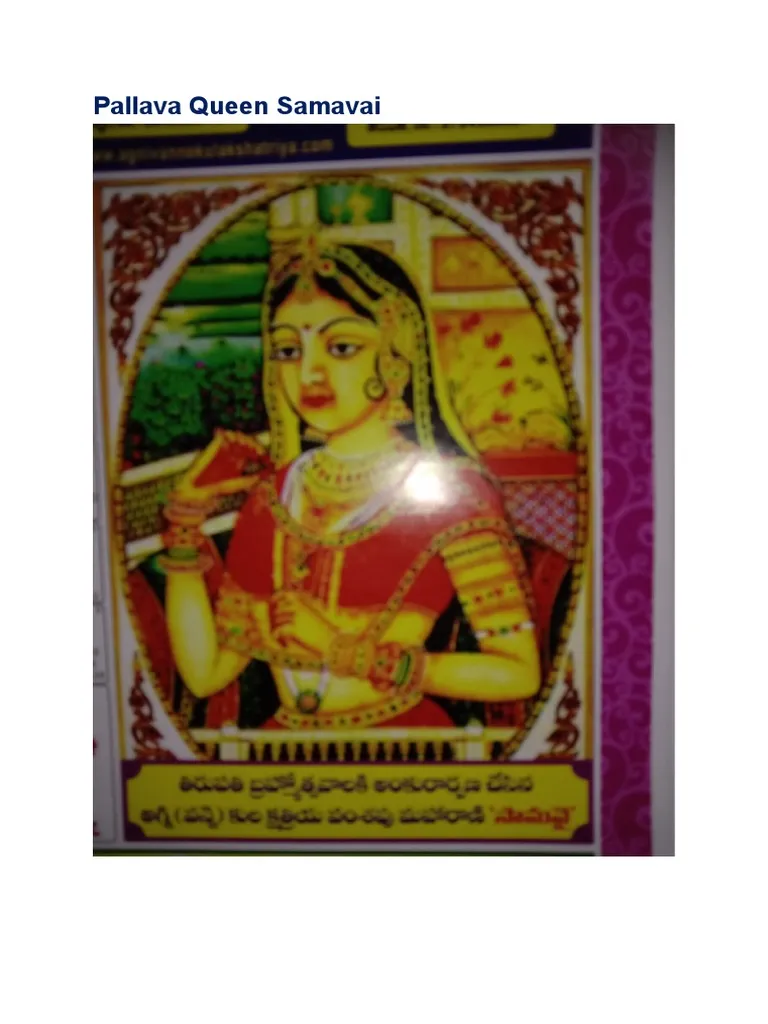

The first recorded endowment was made by Pallava queen Samavai in the year 966 CE. She donated many jewels and two parcels of land (one 10 acres and other 13 acres) and ordered use of the revenues generated from that land for the celebration of major festivals in the temple.[15] The Pallava dynasty (9th century), the Chola dynasty (10th century), Reddi kingdom (12th and 13th centuries) and Vijayanagara pradhans (14th and 15th centuries) were committed devotees of Venkateswara. The temple gained most of its current wealth and size under the Vijayanagara Empire, present-day Karnataka state, with the donation of diamonds and gold.[16] In the 16th century, Vijayanagara Emperor Krishnadevaraya was a frequent donor and visitor to the temple. His donations of gold and jewels enabled the Ananda Nilayam (inner shrine) roofing to be gilded. On 2 January 1517, Krishnadevaraya installed his own statue in the temple.[17]
After the decline of Vijayanagara Empire, rulers from states such as the Kingdom of Mysore and the Gadwal Samsthanam worshipped as pilgrims and donated ornaments and valuables to the temple.[citation needed] Maratha general Raghoji I Bhonsle set up a permanent administration for the conduct of worship in the temple. He donated valuable jewels to the Lord which are still preserved in a box named after him.[18] Between 1320 CE and 1369 CE, idols of Ranganathaswamy Temple, Srirangam were brought to this temple for safe keeping.[17][better source needed]
Ramanujacharya’s visits
In the 11th and 12th centuries, Ramanujacharya visited Tirupati three times. During his first visit, he spent a year with his uncle, Tirumalai Nambi, learning the esoteric meaning of the Ramayana. His second visit was to settle a dispute that had arisen between the Saivites and Vaishnavites regarding the nature of the image set up in the Tirumala temple.[19][page needed] During the last visit, at the advanced old age of 102 years[verification needed], the Acharya installed the image of Govindaraja and laid the foundations of the present-day town of Tirupati.[16] Ramanuja streamlined the rituals at the Tirumala temple according to Vaikhanasa Agama tradition and introduced the recitation of Naalayira Divya Prabandham. He also set up Tirupati Jeeyar Mutt in 1119 AD in consultation with Tirumalai Ananthalwan to institutionalise service to the deity and supervise the temple rituals. To this day, the Jeeyars ensure that the rituals ordained by Ramanuja are observed.[20][21][22]
Modern history
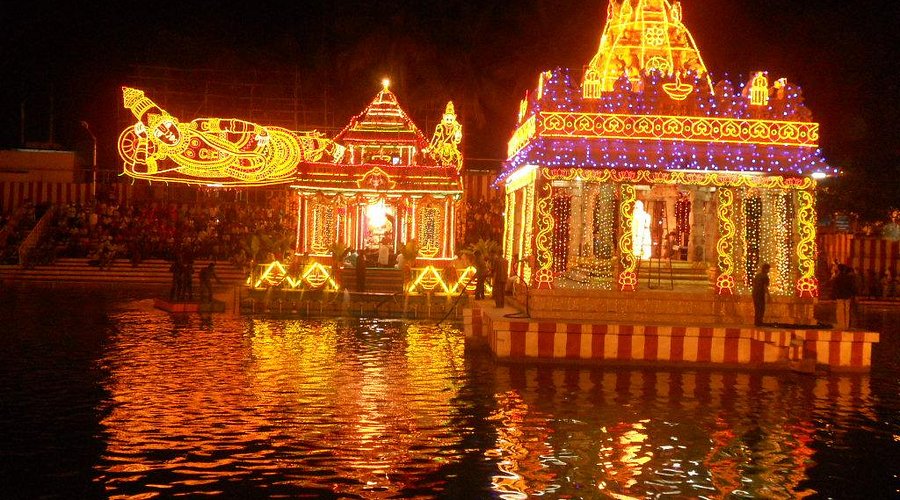
Swami Pushkarni of Tirumala
See also: Establishment and legislative setting of TTD
After the end of Vijayanagara Empire, the temple went into the hands of Golconda in July 1656 and then it was under the French for a short period of time and under Nawab of Carnatic till 1801 CE. With the arrival of the British during the early 19th century, the management of the temple passed to hands of East India Company, who accorded special status to temple and avoided interference in temple activities.[23] Madras government passed Regulation seven of 1817, which passed the temple to Board of Revenue through collector of North Arcot District.[23] In 1821, Bruce, the then East India company commissioner for Chittoor district, had drawn rules for the management of Temple which is referred to as Bruce’s Code.[23] The 7th Nizam of Hyderabad, Mir Osman Ali Khan made yearly donations of ₹8,000 to the temple.[24]
In 1843, the East India Company transferred the Administration of Temple along with other Temples in Tirupati to Mahants of Hathiramji Muth, who acted as Vicaranakartas. It was under the rule of Mahants for six generations until 1933 when Tirumala Tirupati Devasthanams was formed as a result of the TTD Act in 1933.[25] The Act of 1933 was superseded by Madras Hindu Religious and Charitable Endowment Act of 1951.[26] Again in 1966, the temple was placed under direct control of Andhra Pradesh State Endowments Department, with Andhra Pradesh Charitable and Hindu Religious Institutions and Endowments act.[26] In 1979, act of 1966 was rolled back with new Tirumala Tirupati Devasthanams act, where temple administration was vested to a committee consisting of Executive officer, Chairman and two other members nominated by Government of Andhra Pradesh.[26] The temple is run by body Tirumala Tirupati Devasthanams (TTD) which is under control of Andhra Pradesh Government. The head of TTD is appointed by Andhra Pradesh Government. The revenue from this shrine is used by Andhra Pradesh government.[27][28]
Indian Prime Minister Narendra Modi pays obeisance at Tirumala Temple
The temple bears as many as 640 inscriptions in Kannada, Sanskrit, Tamil, Telugu languages.[3] There is a unique collection of about 3000 copper plates on which the Telugu Sankirtanas of Tallapaka Annamacharya and his descendants are inscribed.[29][30] This collection forms a valuable source of material for a historical linguist in Telugu apart from its importance to musicologists.[30]